The DISC Essential Test
Everyone perceives their environment, communicates and behaves in their own way. Knowing and understanding one's own profile and those of one's contacts facilitates effective communication and interaction. The DISC tool, an acronym for Dominant, Influential, Steady and Conscientious, can help you do just that.
What's your profile?
The test consists of 25 questions and should take around ten minutes. We advise you to take it without consulting the documentation first. Explanations will be provided along with your results once the test has been completed.
The DISCp4 Essential test is available at the preferential rate of
It's essential that you answer spontaneously and honestly, without thinking too much or lying to yourself. This test is neither an IQ evaluation nor a psychological examination. There are no right or wrong answers, the aim being simply to understand yourself better and improve your communication.
Your results are confidential. They will not be used for personal or commercial purposes. They will be neither resold nor transferred.
Please note that the DISCp4 Essential test is intended for individuals and professionals who want to discover the DISC model and our services. The DISCp4 Essential test is not recommended for other professional or training purposes. For professional use, we recommend you take the DISCp4 Pro test. Consult our package comparison table to choose the best option for your needs.
What is the DISC model?
The DISC model is a behavioral assessment tool designed to help you better understand how you behave and communicate, as well as how others do. It identifies four main behavioral styles: Dominance, Influence, Steadiness, and Conscientiousness.
Understanding behavioral differences
Everyone perceives situations, communicates, and reacts in their own way. Faced with the same situation, two people may respond very differently, without one response necessarily being better than the other.
Yet we naturally tend to communicate with others the way we would like them to communicate with us. Effective communication, however, is about adapting your message and behavior to the preferences of the person you are communicating with.
The four DISC styles
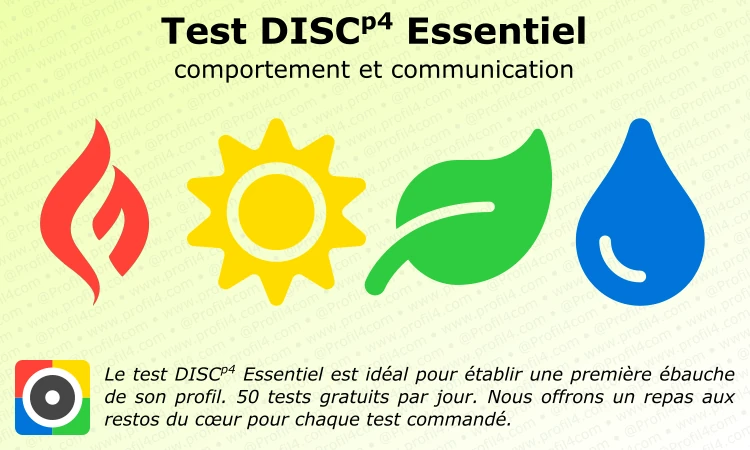
The DISC model groups behaviors into four main styles: Dominance (D), Influence (I), Steadiness (S), and Conscientiousness (C). We all display these four components, but in different proportions.
Understanding how they combine can help you identify your behavioral preferences and communication style, while also making it easier to recognize those of others.
What does a DISC profile measure?
A DISC profile describes behavioral and communication tendencies in different situations: when facing a challenge, interacting with others, dealing with stress, or following rules and procedures.
It does not measure intelligence, abilities or skills, personal values, or mental health. DISC is therefore neither an IQ test nor a psychological assessment.
What is the DISC model used for?
Understanding your DISC profile can help you become more aware of your own preferences and recognize those of others. This knowledge can help you adapt your communication, work more effectively with others, and reduce misunderstandings.
In a professional setting, the DISC model can also help improve team relationships, support task allocation, and adapt management styles to different team members.
Comparative test features
The Essential test is ideal for discovering the DISC model.
The Pro test allows for deeper insight and is particularly suited to professional contexts.
|
Essential |
Pro |
|
|---|---|---|
| Target | Private individuals | Professionals |
| Use | Personal discovery | HR, coaching, training |
| Number of questions | 25 | 70 |
| Test duration | 10-15 min | 15-20 min |
| Results | ||
| Web report An instant, detailed profile view. cf. examples. | ||
| PDF Report Printable, for use in training or coaching sessions as a personal development guide for both individuals and groups. See examples below. | - | |
| Distribution graph The essential graph to illustrate how a profile corresponds proportionally to its main components. | ||
| Trends graph A precise, comparative view of the adapted and natural profiles, in terms of their trends and their magnitude. | - | |
| Advanced study Decision-making, error management, stress management, conflict management, emotions, difficulties, fears... | - | |
| Motivations The BRAPHIS index focuses on the elements most likely to motivate behavior in a given context. | - | |
| Management NEW: Tips for using our managerial tools. | - | |
| Chronoplanning NEW: How someone's chronotype influences the most efficient way to organize their working day. | - | |
| Management | ||
| Test assignment Referrers can assign tests to their colleagues or clients, cf. manuals. | - | |
| Visibility Referrers choose when results will be available for viewing. | - | |
| Workbooks Workbooks can be used to organize profiles according to different criteria. | - | |
| Team graphs The model unleashes its full potential when used in groups. | - | |
| Workbook report Printable summary of team profiles. | - | |
| Start | Start |