The 12 behavioral dimensions
The DISC color wheel
Origins of the DISC
The red profile: dominant
The yellow profile: influent
The green profile: stable
The blue profile: Conscientious
8 trends
12 behavioral dimensions
Communication and Behavior
Motivations - ODAPHIS index
Conflict management
Stress management
Managing mistakes
Improving your sales pitch
Management
At work
Chronoplanning
Videos and podcasts
Further research
The four DISC dimensions describe a person's primary behavioral preferences. The 12 behavioral dimensions complement this analysis by exploring the interactions between pairs of DISC dimensions in relation to one another. They provide deeper insight into how a person makes decisions, communicates, collaborates, takes action, organizes their work, and more.
The following chart is an example. It illustrates the level of expression of the DISC energies through the 12 behavioral dimensions. The dimensions below the diagonal are expressed below their full potential, while those above the diagonal are more heavily mobilized and therefore require greater effort to sustain.
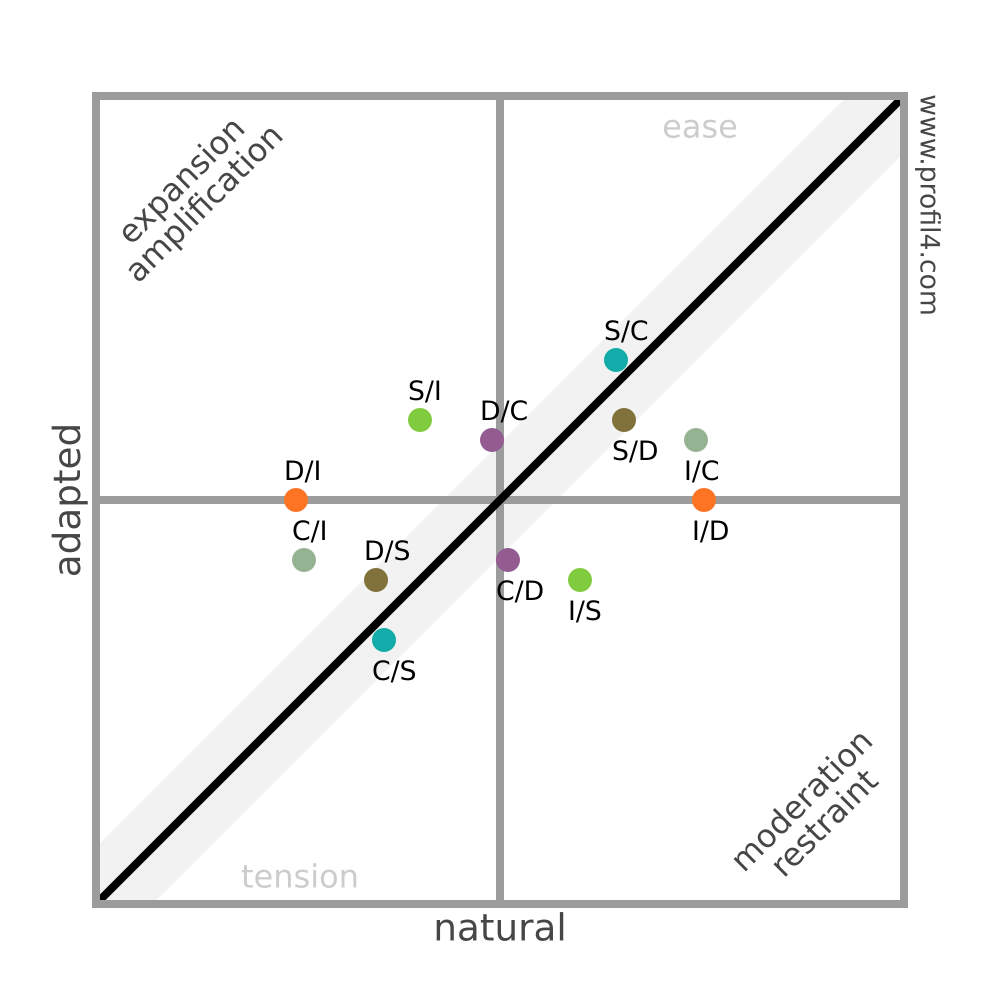
Note: The dimensions operate in pairs, represented by matching colors. For example, Taking a stand (D/I) is paired with Influencing others (I/D). On the chart, these two dimensions appear in symmetrical positions around the center, illustrating their complementary relationship.
Taking a stand (D/I)
Taking a stand describes how a person expresses their convictions, defends their ideas, and contributes to decision-making. This dimension reflects the balance between the Dominance style, which emphasizes assertiveness, decisiveness, and action, and the Influence style, which favors dialogue, persuasion, and building commitment.
A high score reflects a tendency to take a position quickly, express opinions clearly, and defend choices with confidence, even in complex situations or when decisions are difficult. Conversely, a lower score reflects a preference for discussion, consultation, and developing solutions collaboratively before making a commitment.
This dimension does not measure decision-making ability, but rather the preferred way of asserting one's point of view. It highlights the communication style a person naturally adopts when influencing decisions or advancing ideas.
Action pace (D/S)
Action pace represents the natural speed at which a person prefers to act, make decisions, and move activities forward. This dimension reflects the balance between the Dominance style, which values speed, challenge, and action, and the Steadiness style, which emphasizes consistency, stability, and methodical progress.
A high score indicates a preference for a fast pace, quick decision-making, and immediate action when circumstances require it. Conversely, a lower score reflects a more gradual approach, allowing greater time for observation, reflection, and consolidation before taking action.
This dimension does not measure motivation or workload. It describes the natural tempo at which a person is most comfortable working and achieving their goals.
Autonomy (D/C)
Autonomy reflects the degree of freedom a person prefers to maintain in the way they work, organize their activities, and achieve their objectives. This dimension balances the Dominance style, which values independence, flexibility, and the ability to adapt quickly, with the Conscientiousness style, which favors proven methods, established procedures, and risk management.
A high score reflects a preference for significant autonomy in decision-making, along with the freedom to adapt rules or methods whenever doing so improves effectiveness. Conversely, a lower score reflects a preference for working within a clearly defined framework, relying on structured processes and recognized best practices to support sound decisions and ensure quality outcomes.
This dimension does not measure rule compliance. It describes the degree of freedom a person naturally prefers in order to perform their responsibilities effectively.
Social engagement (I/S)
Social engagement represents the way a person naturally invests in relationships and participates in their social or professional environment. This dimension balances the Influence style, which values interaction, spontaneity, and communication, with the Steadiness style, which favors lasting relationships, attentive listening, and a more measured pace.
A high score reflects a preference for frequent interactions, meeting new people, exchanging ideas, and working in a dynamic environment. Conversely, a lower score reflects a preference for fewer but deeper and more stable relationships, where the quality of the connection matters more than the number of interactions.
This dimension does not measure extraversion. It describes the way a person naturally chooses to build relationships and occupy their interpersonal space.
Self-expression (I/C)
Self-expression describes how a person communicates ideas, shares opinions, and expresses their personality in interactions. This dimension balances the Influence style, which values spontaneity, interaction, and direct expression, with the Conscientiousness style, which favors thoughtful, structured communication supported by objective information.
A high score reflects a preference for spontaneous, lively, and natural expression, with ease in sharing ideas and responding in the moment. Conversely, a lower score reflects a tendency to prepare communication more carefully, choose words thoughtfully, and prioritize accuracy before speaking.
This dimension does not measure self-confidence. It describes the communication style a person naturally adopts when sharing ideas and interacting with others.
Influencing others (I/D)
Influencing others describes how a person engages and mobilizes others around their ideas, projects, or objectives. This dimension balances the Influence style, which emphasizes communication, relationships, and persuasion, with the Dominance style, which is more focused on decision-making, action, and achieving results.
A high score reflects a preference for influencing through relationships, the quality of interactions, and the creation of a positive climate that encourages commitment and buy-in. Conversely, a lower score reflects a tendency to influence more through determination, clear decisions, and a focus on effectiveness, with less emphasis on interpersonal dynamics.
This dimension does not measure sociability. It describes the preferred way a person gains commitment from others and exercises influence.
Team orientation (S/C)
Team orientation describes how a person takes the needs of the group into account in their decisions and working relationships. This dimension balances the Steadiness style, which values listening, cooperation, and harmony, with the Conscientiousness style, which emphasizes objectivity, logic, and adherence to established criteria.
A high score reflects a preference for decisions that preserve positive relationships, encourage cooperation, and consider the human impact on those involved. Conversely, a lower score reflects a tendency to prioritize facts, rules, methods, or objective criteria, even when those choices may be less consensual.
This dimension does not measure empathy or teamwork. It describes the natural balance between considering people and considering objective criteria when making decisions.
Perseverance (S/D)
Perseverance describes how a person maintains commitment over time in pursuit of their objectives. This dimension balances the Steadiness style, which values consistency, patience, and continuity, with the Dominance style, which emphasizes rapid action, challenge, and immediate results.
A high score reflects a preference for steady progress, sustained commitment, and the ability to maintain effort despite difficulties. Such individuals often value stability, cooperation, and the pursuit of lasting solutions. Conversely, a lower score reflects a preference for faster action, more assertive decisions, and achieving results within shorter timeframes.
This dimension does not measure motivation or determination. It describes how a person naturally sustains commitment over time and manages long-term effort.
Reflection time (S/I)
Reflection time represents the amount of time a person naturally prefers to allow themselves before making a decision or taking action. This dimension balances the Steadiness style, which values observation, reflection, and continuity, with the Influence style, which favors interaction, discussion, and developing ideas through dialogue.
A high score reflects a preference for individual reflection, careful analysis of the context, and consideration of consequences before making a decision. Conversely, a lower score reflects a tendency to develop ideas through discussion, test them quickly, and refine decisions through interaction.
This dimension does not measure intellectual ability or speed of understanding. It describes the natural way a person develops their thinking before taking action.
Need for structure (C/D)
Need for structure describes the degree of structure a person prefers in their work environment in order to perform effectively. This dimension balances the Conscientiousness style, which values methods, rules, and risk management, with the Dominance style, which favors autonomy, initiative, and rapid adaptation to changing situations.
A high score reflects a preference for clear guidelines, well-defined procedures, and an organized framework that supports sound decisions and minimizes the risk of errors. Conversely, a lower score reflects a preference for greater freedom of action, with the flexibility to adapt methods according to circumstances and objectives.
This dimension does not measure respect for authority. It describes the level of structure a person naturally needs to perform effectively and confidently.
Analytical thinking (C/I)
Analytical thinking describes how a person processes information before making a decision. This dimension balances the Conscientiousness style, which values analysis, facts, and logic, with the Influence style, which places greater emphasis on intuition, interaction, and creativity.
A high score reflects a preference for gathering information, analyzing data, verifying facts, and seeking solutions based on objective evidence. Conversely, a lower score reflects a tendency to rely more on interactions, new ideas, intuition, or experimentation when making decisions.
This dimension does not measure analytical ability. It describes the preferred way a person forms judgments and reaches decisions.
Attention to detail (C/S)
Attention to detail represents the importance a person places on quality, level of detail, and the reliability of information before taking action. This dimension balances the Conscientiousness style, which values preparation, rigor, and precision, with the Steadiness style, which emphasizes continuity, cooperation, and steady progress.
A high score reflects a preference for carefully prepared decisions based on reliable, verified information, with particular attention to reducing uncertainty. Conversely, a lower score reflects a tendency to prioritize project momentum, interpersonal relationships, and continuity of action without systematically seeking the highest level of precision.
This dimension does not measure perfectionism. It describes the level of precision a person naturally considers necessary to act with confidence.